 CorPhylaxis
HeartDecoder: the complete system
From injury-linked signals in plasma to tissue-informed decoding, biological stratification and mechanism-matched development.
HeartDecoder
A research platform designed to connect cardiac cell states with circulating molecular signals—bringing mechanism-based patient selection closer to cardiovascular development.
Beyond clinical similarity
Anchor blood-based molecular signals to cardiac cell states in the Virtual Heart, with the aim of selecting patients by mechanism.
Explore the system, stage by stage.
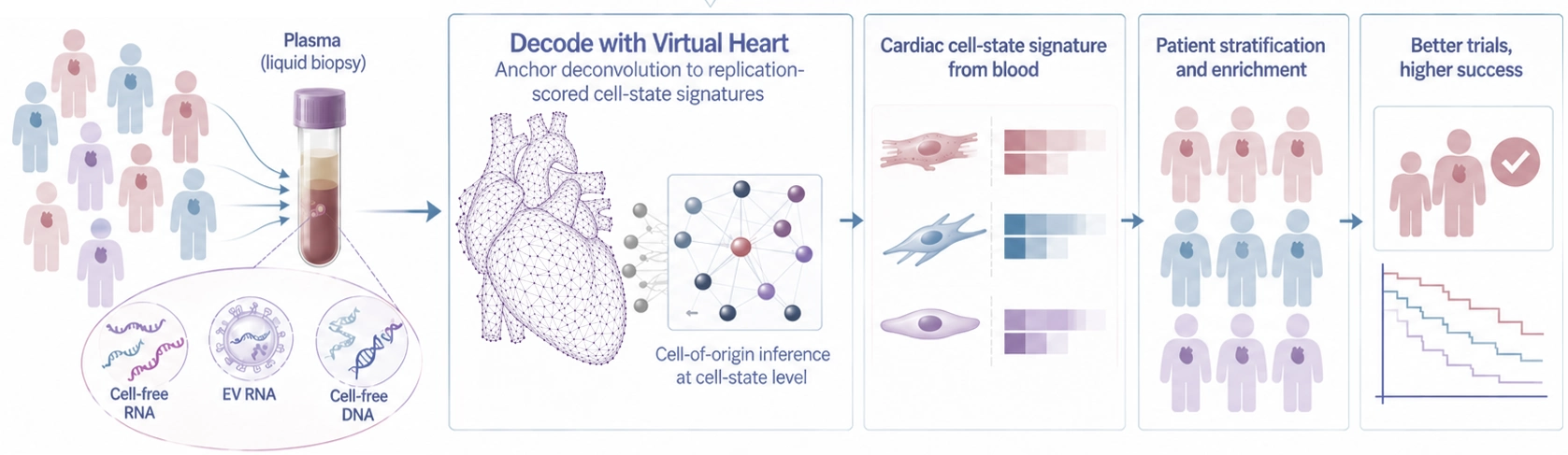
From injury-linked signals in plasma to tissue-informed decoding, biological stratification and mechanism-matched development.
Routine imaging describes organ-level structure and function, while direct sampling of the living heart is limited. Circulating nucleic acids can retain information about tissue and cell of origin. HeartDecoder is being developed to connect these accessible signals with the cardiac cell-state biology resolved by the Virtual Heart.
Plasma contains cell-free RNA, extracellular-vesicle RNA and cell-free DNA. These complementary analytes may preserve traces of tissue origin and biological activity. HeartDecoder’s research workflow studies these circulating signals against tissue-informed cardiac signatures, with matched tissue–blood pairs providing a link between the accessible sample and its biological context.
The Virtual Heart supplies replication-scored cardiac cell-state signatures. HeartDecoder anchors circulating molecular signals to this reference and learns from matched tissue–blood data. The aim is cell-of-origin inference at the cell-state level: a readout connected to the mechanism a therapeutic program intends to change.
A target defined by a cardiac cell state suggests a corresponding patient-selection question: in whom is that state active? HeartDecoder is designed to derive a target-linked circulating signature that can travel with a mechanism from discovery into clinical-development research, including responder analysis and longitudinal monitoring.
Ejection fraction, symptoms, comorbidities and conventional biomarkers can group patients with different disease mechanisms. A target-linked cell-state readout offers a research layer alongside these clinical measures. Retrospective biobank studies and matched outcome data can help evaluate whether a signature identifies biologically relevant patient groups.
Initial research applications include responder analysis and cardiac-safety monitoring. Mechanism-linked stratification may help sponsors design more informative studies and investigate heterogeneous responses. Each partnered tissue–blood–outcome dataset can strengthen the reference. Improved trial success remains a development objective, not demonstrated clinical performance.
Routine imaging describes organ-level structure and function, while direct sampling of the living heart is limited. Circulating nucleic acids can retain information about tissue and cell of origin. HeartDecoder is being developed to connect these accessible signals with the cardiac cell-state biology resolved by the Virtual Heart.
Cardiac origin · signals released into circulation
Plasma contains cell-free RNA, extracellular-vesicle RNA and cell-free DNA. These complementary analytes may preserve traces of tissue origin and biological activity. HeartDecoder’s research workflow studies these circulating signals against tissue-informed cardiac signatures, with matched tissue–blood pairs providing a link between the accessible sample and its biological context.
Plasma · cell-free RNA, EV RNA and cell-free DNA
The Virtual Heart supplies replication-scored cardiac cell-state signatures. HeartDecoder anchors circulating molecular signals to this reference and learns from matched tissue–blood data. The aim is cell-of-origin inference at the cell-state level: a readout connected to the mechanism a therapeutic program intends to change.
Tissue-informed · cell-of-origin inference
A target defined by a cardiac cell state suggests a corresponding patient-selection question: in whom is that state active? HeartDecoder is designed to derive a target-linked circulating signature that can travel with a mechanism from discovery into clinical-development research, including responder analysis and longitudinal monitoring.
Mechanism-linked · activity relevant to a therapeutic target
Ejection fraction, symptoms, comorbidities and conventional biomarkers can group patients with different disease mechanisms. A target-linked cell-state readout offers a research layer alongside these clinical measures. Retrospective biobank studies and matched outcome data can help evaluate whether a signature identifies biologically relevant patient groups.
Target-relevant · enrichment beyond clinical phenotype
Initial research applications include responder analysis and cardiac-safety monitoring. Mechanism-linked stratification may help sponsors design more informative studies and investigate heterogeneous responses. Each partnered tissue–blood–outcome dataset can strengthen the reference. Improved trial success remains a development objective, not demonstrated clinical performance.
Right biology · a more informed development strategy
The translational link
The patients relevant to a therapeutic mechanism are the patients in whom that mechanism’s cardiac cell state is active.
HeartDecoder anchors circulating nucleic acids to replication-scored signatures in the Virtual Heart and learns from matched tissue–blood pairs. This ties an accessible plasma signal to the biological context of the heart.
Clinical phenotype remains essential, but similar ejection fractions, symptoms and conventional biomarkers can conceal different underlying mechanisms. Target-linked signatures are being studied as a complementary layer for retrospective stratification, responder analysis and longitudinal monitoring.
Matched tissue, blood, imaging and outcome data from partnered studies can strengthen both patient-selection research and the cardiac reference. Analytical qualification and validation for a defined application remain development steps.
Collaborate on translation
Explore biological heterogeneity within existing cohorts and biobanks, beginning with a clearly defined scientific question.
Investigate target-linked signatures that may help explain variation in response and inform future enrollment strategies.
Study how circulating signatures relate to cardiac imaging, disease progression and functional outcomes over time.
Explore a research partnership for patient stratification, biomarkers or mechanism-based cardiovascular development.