 CorPhylaxis
CorSilico: the complete system
Human cardiac data, evidence-ranked hypotheses and staged experimental validation form one learning loop.
CorSilico
From millions of human cardiac cells to evidence-ranked hypotheses, staged validation and the next discovery decision. This is the system behind our founding discovery.
The platform workflow
A connected architecture that concentrates experimental work on the hypotheses with the strongest evidence.
The world’s largest harmonized human heart-failure cell data engine, by our assessment.
Explore the system, stage by stage.
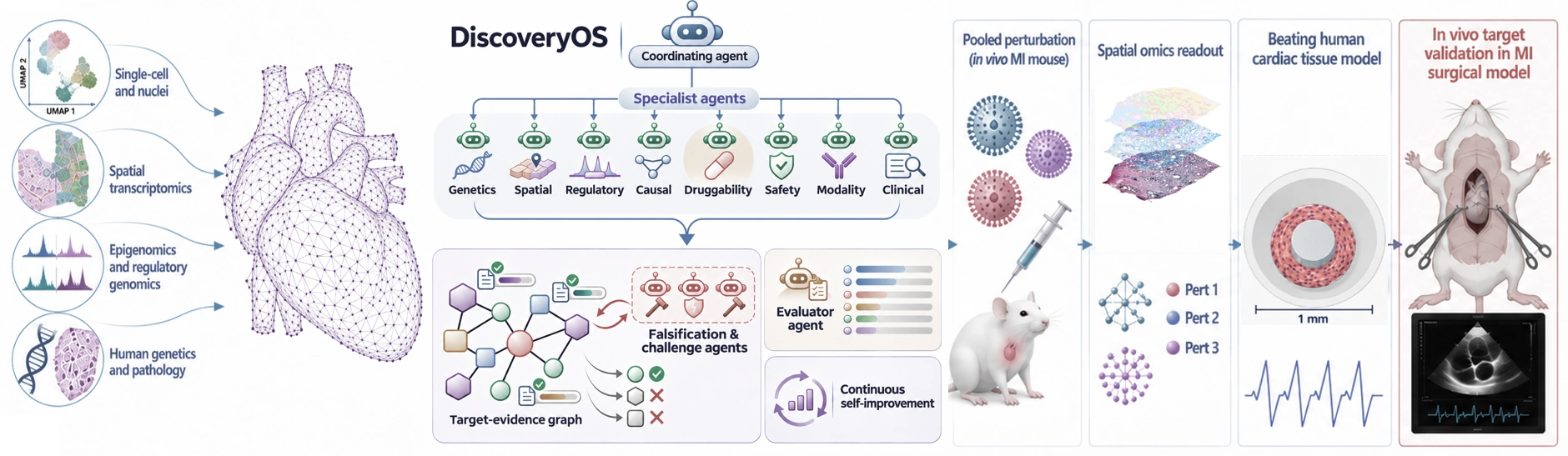
Human cardiac data, evidence-ranked hypotheses and staged experimental validation form one learning loop.
More than 2.5 million human cardiac cells and nuclei are integrated with spatial transcriptomics, epigenomics, human genetics, pathology, imaging and outcomes. The Virtual Heart resolves cell-state programs across cardiac and immune lineages, providing a human disease map from which therapeutic hypotheses can be nominated.
A coordinating scientific AI system integrates specialist analyses across genetics, spatial biology, regulatory genomics, causal networks, safety, druggability, modality and clinical evidence. Independent challenge steps test competing explanations. Evidence and uncertainty are retained in a target-evidence graph, and experimental outcomes inform subsequent prioritization.
Pooled in vivo perturbations compare candidate mechanisms efficiently. Single-cell and spatial readouts examine which cellular states respond, where the response occurs and whether protective programs are preserved. This sequence narrows a broader experimental set to the few mechanisms that merit deeper functional investigation.
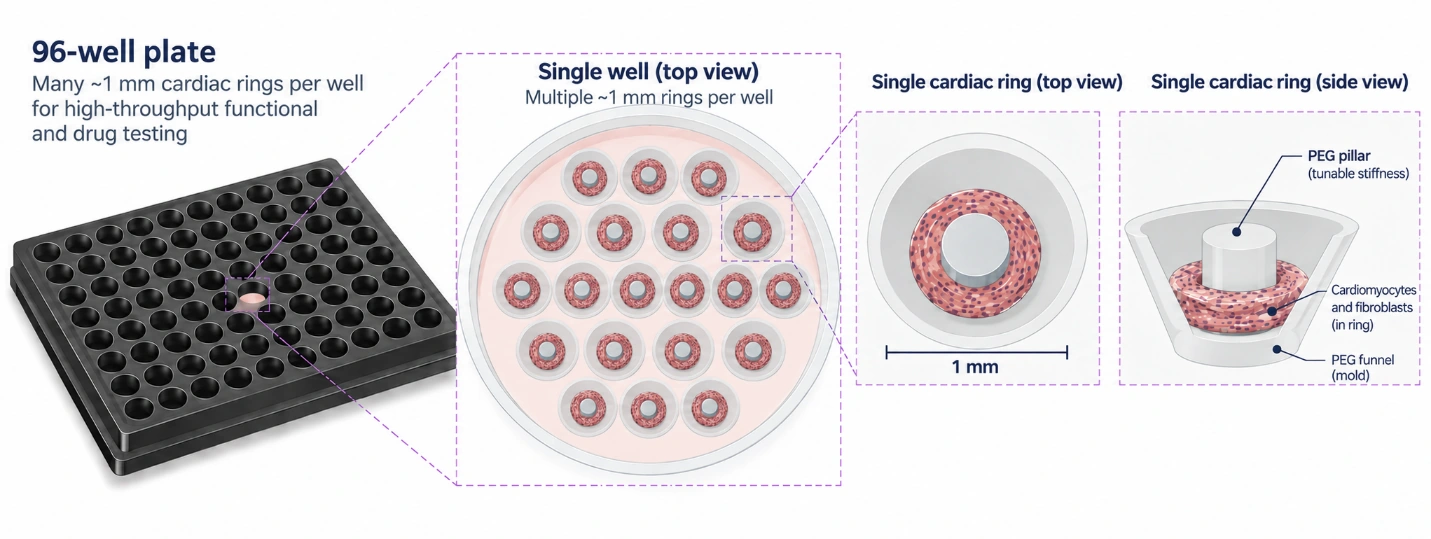
Beating human cardiac rings provide a human-relevant functional tier between molecular screening and intact-heart experiments. The strongest hypotheses advance to focused mouse myocardial-infarction studies with serial echocardiography, scar-architecture histology, spatial readouts and safety endpoints. Positive and negative results return to the engine as comparable causal evidence.
More than 2.5 million human cardiac cells and nuclei are integrated with spatial transcriptomics, epigenomics, human genetics, pathology, imaging and outcomes. The Virtual Heart resolves cell-state programs across cardiac and immune lineages, providing a human disease map from which therapeutic hypotheses can be nominated.
500–700 · candidate hypotheses
A coordinating scientific AI system integrates specialist analyses across genetics, spatial biology, regulatory genomics, causal networks, safety, druggability, modality and clinical evidence. Independent challenge steps test competing explanations. Evidence and uncertainty are retained in a target-evidence graph, and experimental outcomes inform subsequent prioritization.
30–60 · prioritized candidates
Pooled in vivo perturbations compare candidate mechanisms efficiently. Single-cell and spatial readouts examine which cellular states respond, where the response occurs and whether protective programs are preserved. This sequence narrows a broader experimental set to the few mechanisms that merit deeper functional investigation.
10–20 → 3–5 · from perturbation to spatial validation
Beating human cardiac rings provide a human-relevant functional tier between molecular screening and intact-heart experiments. The strongest hypotheses advance to focused mouse myocardial-infarction studies with serial echocardiography, scar-architecture histology, spatial readouts and safety endpoints. Positive and negative results return to the engine as comparable causal evidence.
1–2 · candidates in focused functional studies
Integrate single-cell and single-nucleus data with spatial transcriptomics, epigenomics, genetics, pathology, imaging and outcomes. Cell-state programs are examined across cohorts and disease contexts to separate replicated biology from dataset-specific signals.
Specialist analyses connect cell-state relevance, human genetics, regulatory programs, causal networks, selectivity, safety and therapeutic tractability. Challenge-and-rank steps preserve the evidence and uncertainty behind each hypothesis, while measured outcomes inform subsequent prioritization.
Pooled in vivo perturbation reduces a broader set of candidates to the mechanisms that change the intended biology. Spatial readouts then examine the affected cellular neighborhoods and protective programs, concentrating further functional work on the most informative hypotheses.
Human cardiac rings provide a functional tissue tier. Focused mouse myocardial-infarction studies connect candidate mechanisms with serial echocardiography, scar architecture, histology and structural safety. These complementary models return a causal record to the discovery engine.
Positive and negative outcomes become evidence for the next decision—connecting cell state, intervention, tissue response and cardiac function.
Human-relevant validation
The human cardiac tissue tier is designed to ask whether a molecular change translates into a functional tissue response.
The scientific horizon
A representation of the heart that connects cellular mechanisms to tissue behavior and organ function.
As human data and experimental outcomes accumulate, we are building the foundation for a cardiac-specific model of disease and response to intervention.
The long-term objective is a vertical cardiac foundation model. Today’s engine creates discovery evidence while we build toward that future capability.
Partnership opportunities
Explore cell-subpopulation-specific therapeutic opportunities within an agreed cardiovascular disease area or biological question.
Examine a target’s distribution across disease-driving and protective cardiac states to inform a discovery or development decision.
Define an experimental strategy connecting cellular mechanisms, spatial context and functional readouts.
Connect complementary cardiac datasets, tissue resources and scientific expertise to an explicitly scoped research program.
Discuss a target-discovery question, a human biology challenge or a potential research collaboration.